Research

For humans it is almost impossible to orient themselves in the marine environment without technical equipment because underwater vision is often restricted due to darkness and turbidity and above water, when offshore, there do not seem to be many cues available for a successful orientation - at first glance. In contrast marine mammals are well orientated. They are able to locate foraging grounds and sites of reproduction, undertake seasonal migrations as well as return to haul out places precisely. The basis of these orientation abilities of marine mammals such as seals, toothed and baleen whales, manatees, and otters have been the scientific focus of zoologists and engineers for a long time. However up to now not much is known about the information these animals use for small and large scale navigation. On the one hand this is due to the fact that the underwater world is still hardly accessible and that experimental work with wild animals in their habitat is difficult. On the other hand the sensory abilities of these animals were investigated primarily under laboratory conditions so far, and sensory adaptations to the aquatic environment were interpreted in comparison to the performance and function of sensory systems of terrestrial mammals. Furthermore, scientists have missed so far to look at orientation in the aquatic environment as a multimodal controlled cognitive process.

The aim of our scientific work is to investigate already known orientation mechanisms as well as to unravel information channels available in the marine environment which were so far neglected. In the end we hope to obtain a complete picture of all the mechanisms used by marine mammals for orientation.
Seal projects

On this page, you will find detailed information about individual research projects involving seals.

Directional hearing in the median plane

Directional hearing in the median plane has become a focus of interest, as all land-dwelling mammals use their auricles for this purpose, whilst seals do not possess auricles. This raised the question of whether they are able to distinguish between up and down, as well as front and back, and how they manage to make this distinction.

In the video, Sam the seal is lying on his side in the water in a resting position. A sound is played to him either directly above his head – as shown in the video – or below his head. He then indicates, by moving his head, the upper or lower response ball from where, according to his perception, the sound was played.

Haptic matching

In a ‘matching’ task, the test animal is first presented with a stimulus (‘sample’) and then with two comparison stimuli. Only one comparison stimulus – the so-called positive stimulus – is identical to the ‘sample’. The animal’s task is to select the positive stimulus. Visual ‘matching’ tasks proved quite difficult for seals to learn, which is why we are now investigating how well a ‘matching’ task can be learnt if the seal is able to feel the objects with its whiskers.

In the video, you can see how the seal is masked; on the one hand, with a mask over its eyes to prevent it from solving the task visually, and on the other, with headphones to ensure that acoustic signals do not provide clues to the correct solution when the stimuli are presented. The animal first touches the ‘sample’ in the middle, then explores the two comparison stimuli, and finally, if it makes the correct choice, pushes the positive stimulus backwards. In this example, the stimuli differ in size.

Hydrodynamic track-following

Seals are able to detect and track the hydrodynamic wakes of objects moving through the water using only their whiskers (Dehnhardt, Mauck & Bleckmann 1998; Dehnhardt et al. 2001).

In the video, you can see how Sam the seal precisely tracks the hydrodynamic wake of a remote-controlled submarine. Whilst the trail is being laid, Sam is fully masked: his whiskers are out of the water so he cannot feel anything, he is wearing headphones so he cannot hear anything, and he is wearing a mask over his eyes so he cannot see anything. Once the submarine comes to a standstill – meaning there are no longer any audible clues as to its position – the seal is allowed to search for and track the wake, whilst still wearing the mask to prevent it from spotting the submarine with its eyes. Seals could use this astonishing ability to detect and track the hydrodynamic trails of their prey – the fish – and ultimately catch them.

Hydrodynamics involving individual vortex rings

In numerous experiments, seals have demonstrated that they can extract a wide range of information from a complex hydrodynamic wake. Within these wakes, vortices are found which appear to carry the key information. The question now arose as to whether seals are also capable of detecting individual vortices. In the experiment, these are generated using a vortex generator, and specific parameters of the vortices can be varied. This study helps to understand the functioning of the whiskers in detail.

The video shows Filou the seal taking up his position underwater, wearing a mask over his eyes to prevent him from solving the task visually. A vortex is triggered on one side (for demonstration purposes, the water in a vortex generator was coloured green). The vortex travels towards the seal, which senses it using its whiskers and tells the experimenter from which side the vortex came.

Hydrodynamic predator-prey interaction

Flounder form an important part of the seals’ diet. Despite their cryptic appearance and despite burrowing into the sediment, seals are therefore able to detect flounder. This ability may be based on the flounder’s exhaled water currents. The aim of this experiment is to test whether seals can locate, using only their whiskers, subtle water movements – initially artificially generated to mimic the breath currents of flounder, and later a real flounder – within an area measuring 4 x 4 metres.

Determining direction from a hydrodynamic wake

In addition to their ability to detect and track hydrodynamic trails, seals are capable of determining, from a hydrodynamic trail, the direction in which, for example, a prey fish has swum. This finding was obtained in a behavioural experiment in which the seal indicated the direction of a paddle being dragged through the water (Wieskotten et al. 2011).

The video shows a top-down view of a water tank. Suspended particles have been added to the water in the tank, which are illuminated by a laser in a single plane. A small paddle is then pulled across the tank from right to left; the resulting vortices are clearly visible. Shortly afterwards, Henry the seal, wearing a mask over his eyes, comes across the trail and is able to determine the direction of the paddle’s movement in a flash, using only his whiskers. These images can be analysed in detail with the aid of a computer.

Perception of DMS

Dimethyl sulphide (DMS) is an odour compound that is released when phytoplankton is eaten by,
for example, small crustaceans (zooplankton). The ability to detect DMS would lead a seal directly to these areas of high productivity, where it would then find plenty of prey. In this experiment, the seals’ detection threshold for DMS was determined. Seals proved capable of detecting minute traces of DMS (Kowalewsky et al. 2006). An open-field experiment on the open sea can now be used to test whether, for example, wild seals specifically swim towards areas with elevated DMS concentrations.

Perception of salinity gradients

Oceans exhibit vertical and horizontal salinity gradients of varying intensity, which differ from place to place. The ability to detect these salinity gradients could be used by seals for orientation. Seals have been shown to be highly sensitive to differences in salinity as they occur in their environment (Sticken et al. 2000). This provides the basis for gustatory orientation in the marine habitat.

Thermoregulation

In cold water, the animals face the problem of not losing too much heat due to water’s high thermal conductivity. They have therefore developed insulation mechanisms that prevent excessive heat loss. On land, however, the opposite problem often arises, i.e. excess heat must be dissipated. Research at the Marine Science Center has shown that, in grey seals, this is achieved via so-called ‘thermal windows’ – areas of skin with a rich blood supply (Mauck et al. 2003). This project also investigated comparative thermoregulatory aspects in fur seals.

In the video, which was recorded using a thermal imaging camera, one can see how thermal windows form on a seal’s body near its hind flippers. The temperature in the thermal imaging camera’s images is colour-coded, with blue representing low temperatures down to a minimum of 18 °C and red representing high temperatures up to a maximum of 38 °C.

Visual discrimination in fishes

Fish possess numerous sensory systems, including hearing and the hydrodynamic sense, chemical senses, temperature perception and, frequently, passive or active electrosensory systems. Furthermore, they are the vertebrates that first developed the eye. A series of experiments has focused on the specific adaptations of the fish eye to a wide variety of ecological conditions. For example, the visual acuity of the European eel (Anguilla anguilla) and the Indian mudskipper (Periophthalmus novemradiatus) was measured under various conditions. These two fish species are characterised by completely different lifestyles, yet both can survive in water and on land. Furthermore, the mudskipper leads an almost entirely terrestrial lifestyle.

The video shows a dual-choice experiment to determine the visual acuity of the Indian dwarf mudskipper. The animal enters the frame from the left and selects the striped stimulus, for which its choice is rewarded. By gradually increasing the difficulty of the task, its performance limits can be determined.

Hydrodynamic analysis of fast starts

C-starts and S-starts, collectively referred to as ‘rapid starts’, are rapid flight responses in fish that can be triggered by an acoustic or visual startle stimulus. This project investigates whether the water movements caused by such a flight response are capable of helping predators to track down a fish. Many predators, such as seals or predatory fish, possess the sensory systems required to perceive water movements; however, too little is yet known about whether they are able to analyse and categorise spatial patterns. For this reason, the water movements occurring in the natural habitat are measured using Particle Image Velocimetry (PIV).

The video shows two different high-speed starts and the resulting water movements. The first sequence shows a C-start, the second an S-start. The water movements are depicted as vector fields. In each of the two sequences, three distinct zones of rapid water movement – known as jets – can be identified, which more or less precisely take the form of vortex rings: Jet 1 is generated by the caudal fin, Jet 2 by the body and the caudal fin, and Jet 3 by the body at a later stage. A predator could, in theory, glean valuable information from these jets.

Electroreception in the bottlenose dolphin

Electroreception is the ability to detect electric fields in water and is found, for example, in sharks and rays. In 2012, it was demonstrated that the Guiana dolphin, a toothed whale, can also detect electric fields using its hairless vibrissal follicles on the rostrum, thereby locating prey in the sediment (Czech-Damal et al. 2012). Bottlenose dolphins, too, occasionally search for prey fish hiding in the seabed. In this so-called ‘crater-feeding’ behaviour, the animals burrow their heads into the sand. By detecting the electric fields generated by the fish, the dolphin may be able to locate these fish at close range in this situation.

The video shows the procedure of a single experiment designed to investigate whether bottlenose dolphins are also capable of detecting electric fields. The female dolphin, Donna, swims into the experimental apparatus and assumes a resting position. Directly above her beak is the electrode used to generate the electrical stimuli. The dolphin’s task is to signal that she has detected an electrical signal by leaving the apparatus.

Dog whiskers

Although the dog is one of the first animals to have been domesticated, its sensory systems have been scarcely studied to date. This applies in particular to the dog’s vibrissal system. There are neither morphological studies nor well-founded scientific publications on the sensory physiology of the vibrissal system in dogs. A behavioural experiment is now to be conducted for the first time to investigate how sensitive a dog’s vibrissae are (determination of a frequency-dependent perception threshold). In addition to the behavioural experiments, a description of the external appearance of the dog’s vibrissae across different breeds will be undertaken. This classification of the vibrissae is intended to shed light on breed-specific differences and provide insights into the function of the vibrissae.

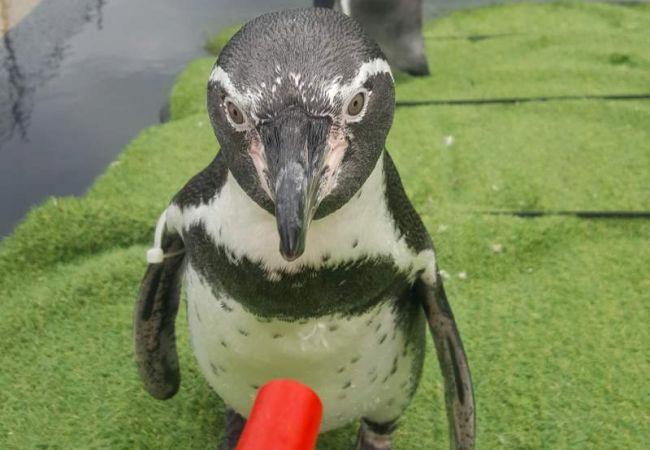
Audiogram of a Humboldt penguin

To date, the frequency range covered by the sense of hearing is known for only a few species of penguin – in other words, it is not known which sounds they can just about hear at what volume. This makes it impossible to determine precisely the impact of anthropogenic noise in their habitat on the various populations and species.

The aim of this project was to determine the frequency range within which Humboldt penguins perceive sound underwater, with the ultimate goal of producing a complete audiogram. To this end, the animals were trained, in a behavioural experiment, to respond with a clear signal when they perceived a sound underwater.