
Research prinicples

Behavioural experiments are usually carried out to study the abilities of all animals. To this end, the animals are trained using the method of operant conditioning. The key to this training method lies in the positive reinforcement of desired behaviours. When the animal displays the desired behaviour, the correct response is first signalled by a short whistle from the training whistle (secondary reinforcer). The whistle is then followed by food (primary reinforcer). This forms the basis for the behavioural experiments, which are usually carried out as detection or discrimination experiments.
In a detection experiment the experimental animal has to signal the presence or absence of a signal. A detection experiment was run e. g. to determine the detection threshold for dimethyl sulphide (DMS), an odorant that could guide seals to profitable foraging grounds (Kowalewsky et al. 2006). In this experiment the seal had to pull its snout out of an apparatus if it was smelling DMS and it had to remain stationary if it was not smelling DMS.

In a discrimination experiment the animal has to discriminate at least two stimuli. Such an experiment was run to measure the seals' visual acuity (Weiffen et al. 2006; Hanke & Dehnhardt 2009). Stripe patterns were presented to the seals pairwise: one horizontal, which was rewarded, and one vertical stripe pattern of the same stripe width. When the stripe width became too thin to be resolved they appeared as grey, and the seals answered randomly. Acuity can be calculated on the basis of the performance of the seals.

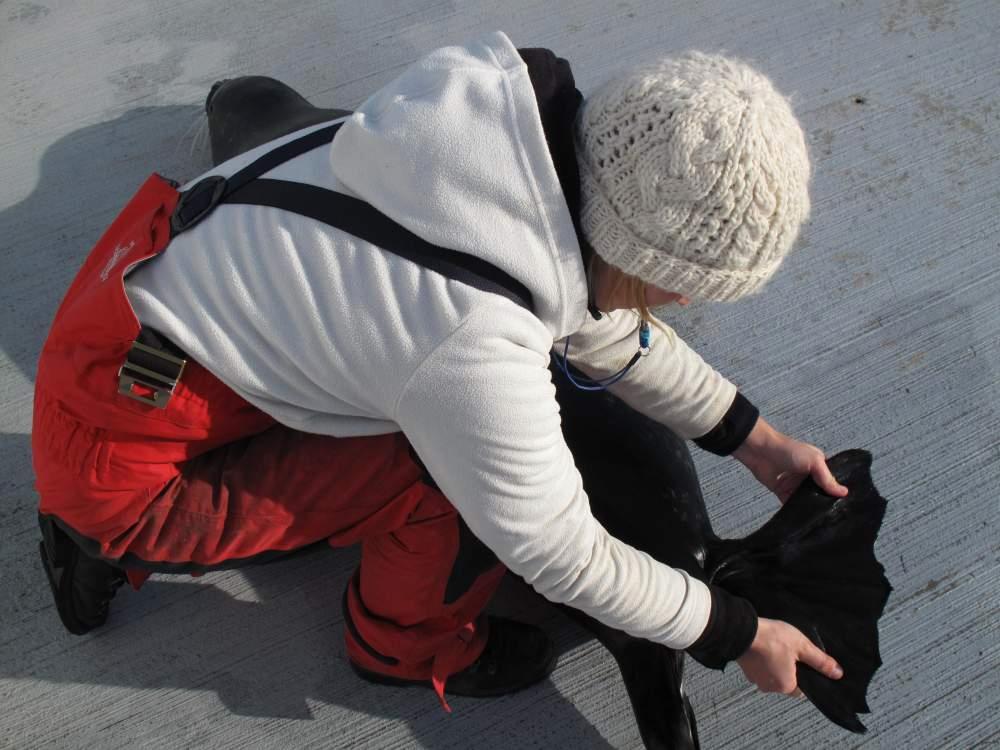
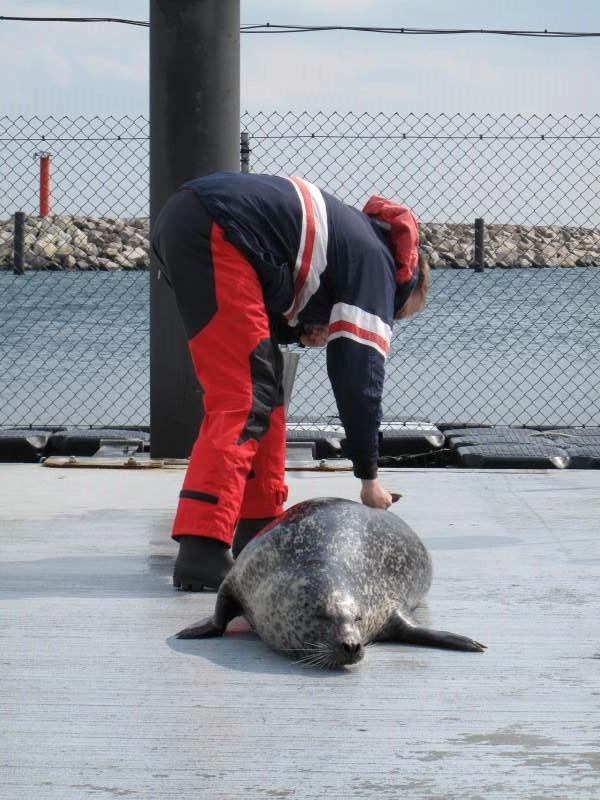
With the help of operant conditioning our seals are trained on many behaviours which are essential for the daily routine, husbandry, regular check-ups, and the mental vitality of the animals.

Besides behavioural experiments we also apply physical and electrophysical measurements, histological and morphological methods up to theoretical modelling and bionic approaches.